
Alarm lights & error codes · Los Altos
Sub-Zero Error Codes & Alarm Lights, Explained
- Service light & alarm decoding
- Classic, Designer & 7000-series
- $89 service call, waived with repair
- Los Altos & nearby Peninsula
Quick answers
What is my Sub-Zero trying to tell me?
- A wrench or "service" light?
- The unit is flagging that it wants attention — sometimes a routine reminder, sometimes a stored fault. It does not mean the refrigerator is failing, but it should be read rather than ignored.
- "Vacuum condenser" message?
- A built-in scheduling reminder to clean the condenser, not a breakdown. Clear the grille and coil; if it returns quickly, airflow or the reminder sensor needs a look.
- Flashing temperature or door alarm?
- The cabinet has drifted warm or a door was left ajar. If it will not clear after the door is shut and the unit recovers, something is keeping it from holding temperature.
- Panel blank, "OFF" or unresponsive?
- Often a control in a standby/showroom state or a power event — but a dead panel with a warm cabinet is a genuine fault. We confirm which before quoting anything.
Lights, not numbers
Sub-Zero alarms are mostly lights, not error codes
Owners often call asking us to "look up the error code," expecting a numbered fault on the display. Most Sub-Zero built-ins do not work that way. Instead the unit communicates through a small set of owner-facing signals — an illuminated service indicator, a vacuum-condenser reminder, a flashing temperature or door-ajar alarm, and on some models a chime. These are deliberately simple, because the design philosophy is to keep your kitchen calm rather than scroll cryptic numbers across the front of a panel-ready cabinet.
Behind that calm front, however, the control board often stores far more: sensor readings, fault history and, on the newer generations, internal diagnostic states a technician can step through in a service mode. So when your unit shows a single light, that light is the headline — the real story is in the readings underneath it. That is the gap this page is meant to close: tell you honestly what the visible alert means, what you can safely resolve, and where a proper diagnosis takes over.
Alert → meaning → action
The owner-facing alerts you will actually see
A plain-language reference to the Sub-Zero alerts Los Altos owners ask about most, and whether each is a do-it-yourself moment or a call.
| What you see | What it usually means | Owner vs technician |
|---|---|---|
| Service / wrench indicator | A scheduled reminder or a stored fault flagged by the control | Read it; if it returns after a reset, have it diagnosed |
| Vacuum-condenser reminder | Time to clean the condenser coil and grille | Owner: vacuum the grille; recurring = airflow or sensor check |
| Flashing temperature alarm | Cabinet drifted above its target range | Owner: shut doors, allow recovery; persistent = technician |
| Door-ajar alarm / chime | A door or drawer is not fully closing or sealing | Owner: check load and gasket; if sealed yet alarming = call |
| "PC" / power-cool or standby state | A control mode, not always a fault | Confirm the mode; a stuck or blank panel needs diagnosis |
| Sensor / "EC"-type fault (newer columns) | A thermistor or control circuit reading out of range | Technician: measured, then the specific part replaced |
Exact behavior varies by series and model year — we confirm the meaning on your unit from the control before recommending any part.
Mixed-vintage kitchens
Classic, Designer and 7000-series in the same Los Altos home
Los Altos kitchens are rarely all one generation. A 1990s or early-2000s remodel in Old Los Altos often left behind a Classic built-in — a sturdy refrigerator/freezer with a simple membrane panel and basic alarm lights — while a later renovation added Designer integrated columns or the newer 7000-series with richer electronic controls and a fuller diagnostic mode. It is common for us to service two different Sub-Zero generations in the same home on the same visit.
That matters because the same word — "alarm" — points at different things across generations. An older Classic might simply flash a temperature light, where a newer column can hold a stored sensor fault and a service state you cannot see from the front. The first step is always identifying exactly which unit and series is alerting, which is why your model number guide tag is so useful: it tells us the generation before we arrive, so we bring the right approach and the right parts. If the alert is on a unit that has also stopped cooling, our built-in refrigerator repair and column temperature pages cover what tends to be behind it.
Before you call
What to do when an alert appears
A short, safe sequence that often clears a nuisance alert — and tells us exactly where to look if it does not.
- 1
Note the exact alert and unit
Write down what is showing — a light, a chime, a word like "vacuum condenser" — and which unit it is on. A photo of the panel is ideal and saves time on the call.
- 2
Close and reseat the doors
Make sure every door and drawer is fully shut and nothing inside is blocking the seal. A door-ajar or temperature alarm often clears on its own once the cabinet recovers.
- 3
Clear the condenser if prompted
For a vacuum-condenser reminder, vacuum the grille and the visible coil face. If the reminder returns within days, the airflow or the reminder sensor needs a closer look.
- 4
Reset, watch, then call with detail
Give the unit time to recover and watch whether the alert returns. If it does, call (650) 668-1172 or book online and describe exactly what you saw so we arrive prepared.
When an alert means act now
Most alerts can wait for an appointment, but a few should not. If a temperature alarm will not clear and the cabinet is warming, if you smell anything burning, if the compressor is hot and the unit runs without cooling, or if a panel is dead alongside a warm fresh-food side, treat it as urgent — move perishables and call (650) 668-1172 or book online rather than waiting it out.
How we read it
We read the fault — we do not guess
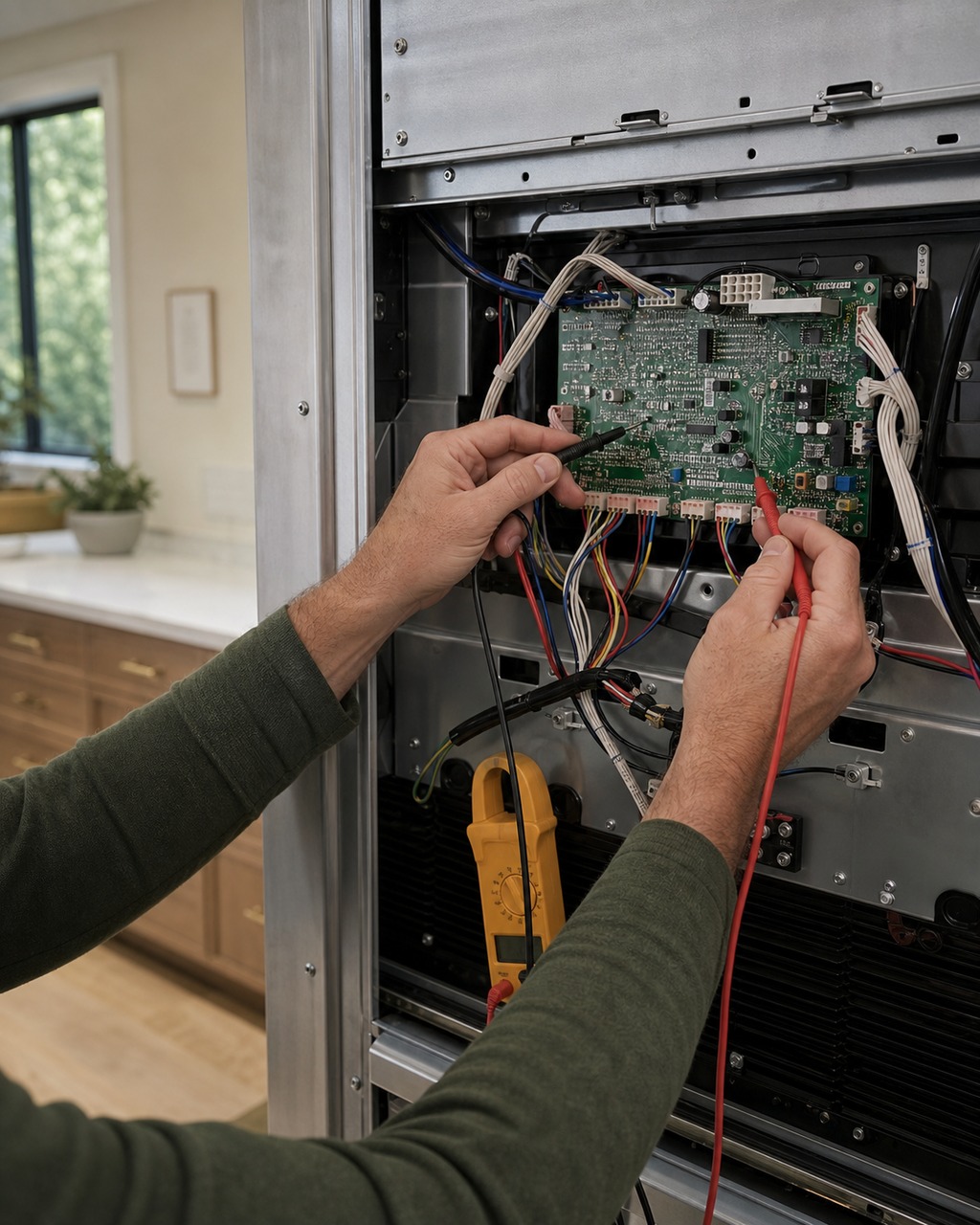
Honest calibration matters here. We do not promise to "clear a code" sight unseen, because on a Sub-Zero the visible light is only the surface. When we arrive we identify the series, enter the control’s diagnostic state where the model supports it, and take the readings behind the alert — the thermistors, the door switches, the defrost and fan circuits, and the board itself. Only then do we name a part, and only after you approve a firm written quote.
That discipline is why an alarm rarely turns into the worst-case repair. A flashing temperature light is far more often a tired sensor, a sticking damper or a door seal than a sealed-system failure — and proving that with measurements protects your budget. You can see the full diagnostic approach on our process page, and planning ranges by repair on the built-in repair cost guide. The $89 service call is waived the moment you approve the work.
Reviews
Decoding Sub-Zero alerts in Los Altos
-
Our built-in refrigerator column stopped holding temperature the week we were hosting. They came out, diagnosed a failing evaporator fan, and had the right Sub-Zero part on the second visit. The $89 service call was applied to the repair and everything is back to a steady 38°F.
-
They pulled our panel-ready unit out without leaving a mark on the white-oak cabinetry — runners down, blankets, the works. Quiet, precise, and they explained the 365-day labor warranty up front. Exactly the kind of careful work an estate kitchen needs.
-
Frost was building on the back wall of the fresh-food side and the fridge ran constantly. Turned out to be a defrost heater and sensor. Clear quote, genuine OEM parts, and the service call fee came off the final bill.
Common questions
Sub-Zero error codes & alarm lights — FAQ
Does Sub-Zero use numbered error codes?
Mostly no. Unlike a car dashboard, most Sub-Zero built-ins communicate through a small set of owner-facing signals — a service or wrench indicator, a vacuum-condenser reminder, a flashing temperature or door alarm, and a chime — rather than scrolling numeric codes. Behind that simple front, the control board stores sensor readings and fault history that a technician can step through in a service mode on the newer generations, which is where the real detail lives.
What does the service or wrench light mean on my Sub-Zero?
It is the unit asking for attention. Sometimes it is a routine reminder, and sometimes the control has flagged a stored fault. It does not mean the refrigerator is about to fail, but it should be read rather than ignored. If the light returns after a basic reset, the sensible next step is a diagnosis so we can pull the readings behind it and tell you what actually triggered it.
My Sub-Zero says "vacuum condenser" — is that a breakdown?
No, that is a built-in maintenance reminder telling you it is time to clean the condenser. Vacuum the grille and the visible coil face, then reset the reminder. It only becomes a service matter if it returns within days, which can mean the airflow is restricted or the reminder sensor needs attention. A clean condenser is also the cheapest way to prevent the slow temperature drift we see over warm Los Altos summers.
Why is my temperature alarm flashing and how do I clear it?
A flashing temperature alarm means the cabinet has drifted above its target range, often after a door was left ajar or a big warm load went in. Close the doors fully, avoid opening them for a while, and give the unit time to recover — many alarms clear themselves. If it keeps alarming while the doors are sealed and the cabinet is not cooling back down, something is preventing it from holding temperature and it needs a technician.
Do the alarms differ between older and newer Sub-Zero units?
Yes. Older Classic built-ins from 90s and 2000s remodels tend to show simple alarm lights, while newer Designer columns and the 7000-series carry richer electronic controls with a fuller diagnostic mode and stored sensor faults. Many Los Altos homes run both generations side by side, so the first thing we do is identify the exact unit and series — the model tag tells us which approach and parts to bring.
Can you clear a Sub-Zero fault over the phone?
We will happily talk you through the safe basics — closing doors, clearing a condenser reminder, resetting and watching the unit. But we do not promise to clear a fault sight unseen, because the visible light is only the headline. The real diagnosis takes readings from the sensors, switches and board on site. We read the fault and prove it before naming a part, then waive the $89 service call when you approve the repair.
Should I keep using the refrigerator while an alert is showing?
It depends on the alert. A vacuum-condenser reminder or a one-time door alarm is fine to keep using while you book. But if a temperature alarm will not clear and the cabinet is warming, you smell anything burning, or the panel is dead while the food is getting warm, move perishables and call promptly. Reach us at (650) 668-1172 or book online and describe exactly what the panel is showing.
Keep reading
Related guides & services
Not sure what your Sub-Zero alert means?
Send us the panel and we will tell you what to check. $89 service call, waived with your repair — and a 365-day labor warranty. Call (650) 668-1172 or book online.