

Sealed system & compressor · Los Altos
Sub-Zero Sealed System & Compressor Repair in Los Altos
- $89 service call, waived with repair
- 365-day warranty on all labor
- Genuine OEM Sub-Zero parts
- Los Altos & nearby Peninsula
Quick answers
Sealed-system and compressor symptoms
- Compressor loud or hot?
- A compressor that runs hot, rattles or hums and trips is often a start-relay, overload or sealed-system issue — not always a dead compressor. We measure before condemning it.
- Not cooling at all?
- When both zones stay warm and the compressor will not run or run-but-not-cool, the sealed system or its electrical circuit is the prime suspect. We confirm with gauges first.
- Evaporator iced over?
- A solid block of ice on the evaporator can starve airflow and mimic a sealed-system fault. We thaw, test the defrost circuit, and check whether refrigerant charge is the real cause.
- Suspect a refrigerant leak?
- Low charge from a leak means weak or no cooling. We pressure-test, locate the leak, and explain whether it is repairable — see the cost guide for ranges.
What the sealed system is
The sealed system is the heart of the cold
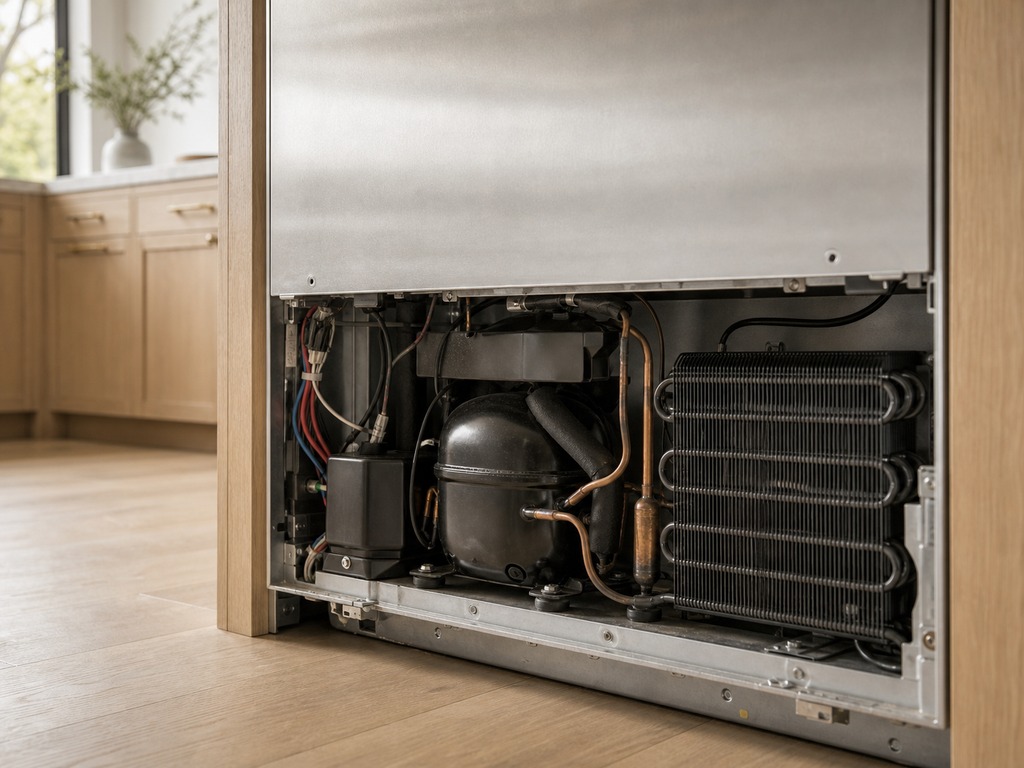
A Sub-Zero built-in cools through a sealed refrigeration system: the compressor pressurises refrigerant, the condenser sheds heat, the refrigerant expands and chills the evaporator, and a fan moves that cold through the cabinet. The refrigerant lines that connect these parts are brazed closed at the factory — which is why a real sealed-system repair is specialised work, not a parts swap. When any link in this loop fails, the symptom is usually the same: it is not cooling at all.
Because the loop is sealed and the consequences are expensive, diagnosis here demands evidence, not guesses. "It's the compressor" is a conclusion, not a starting point. A weak compressor, a stuck start-relay, a restricted line, a slow refrigerant leak and a defrost failure icing the evaporator can all read as "warm fridge" from the front — and the fix and cost for each is completely different.
In a tight estate built-in, the sealed system lives in a cramped cabinet cutout with the condenser and compressor packed at the base. Accessing, gauging and brazing it without disturbing surrounding millwork takes the kind of extensive hands-on experience we have built across Los Altos kitchens. If you are unsure which unit you have, our model number guide shows where the tag lives.
Reading the system
Gauges turn a guess into proof
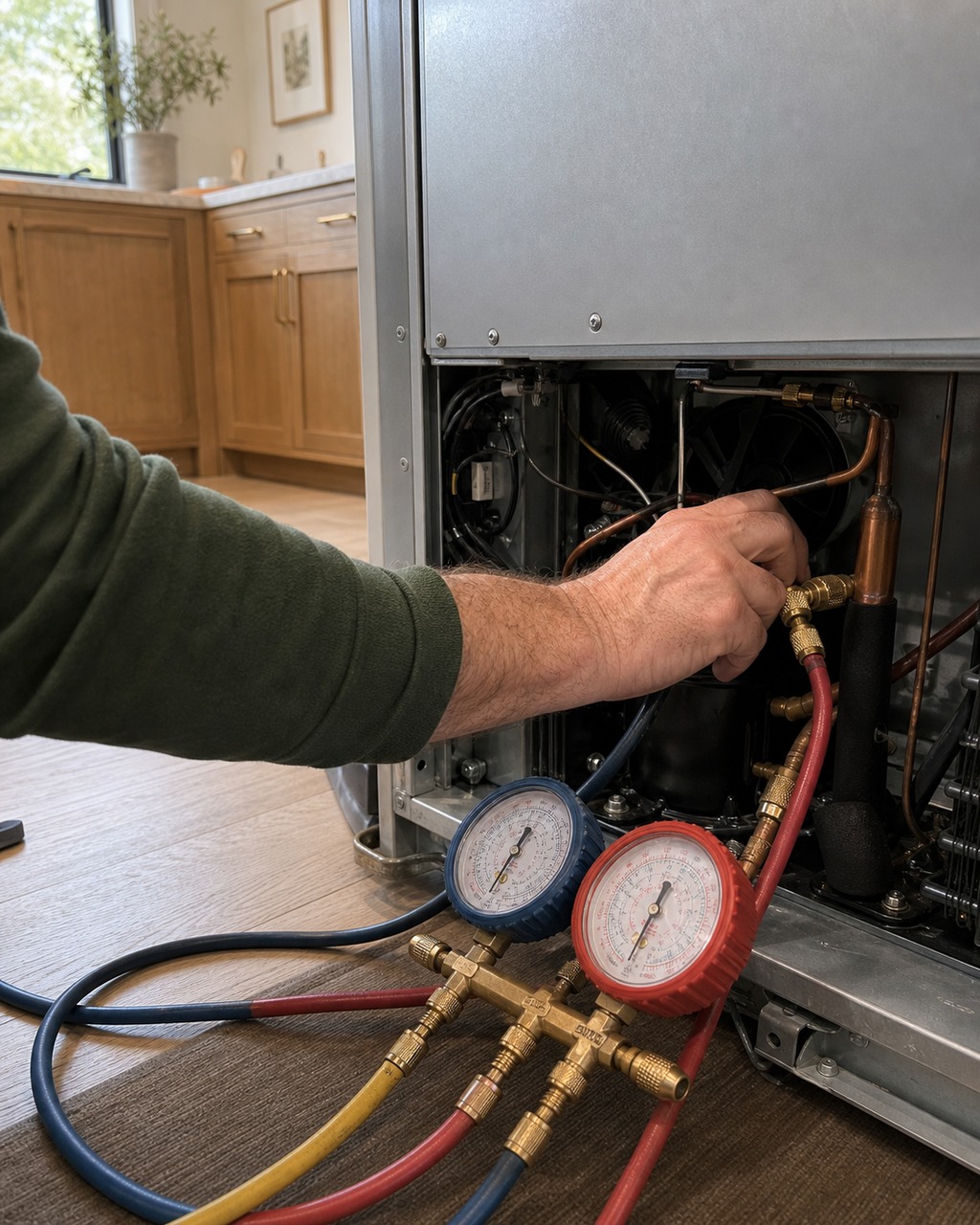
The only honest way to judge a sealed system is to read it. We connect refrigeration manifold gauges and watch high and low side pressures while the compressor runs, alongside amp draw, superheat and the temperatures across the condenser and evaporator. Those numbers tell us whether the charge is correct, whether the compressor is actually pumping, and whether a line is restricted.
Pressure-testing also exposes a refrigerant leak that a quick look never would. If the system is low, we trace where it is escaping rather than simply topping it up and handing you the same failure in a month. Only once the readings agree on a cause do we put a firm number in front of you — so you are paying for a confirmed fault, not a hunch.
Symptom → cause → fix
Sealed-system symptoms we see in Los Altos
How the most common sealed-system and compressor symptoms usually trace back, and what we do once the gauges confirm it.
| Symptom | Likely cause | What we do |
|---|---|---|
| No cooling at all | Failed compressor, start components or lost charge | Gauge the system, test the compressor electrically, confirm whether it is sealed-system or electrical |
| Warm but compressor running | Low refrigerant charge or a restriction | Read high/low pressures, leak-test, locate the restriction or leak before any quote |
| Iced-over evaporator | Defrost failure or charge migration to the coil | Thaw and inspect, test the defrost circuit, verify charge so the ice does not return |
| Hot, loud compressor | Weak compressor, relay or overload protector | Check amp draw and start components, replace the relay/overload if that is the fault |
| Short cycling on the overload | Overload tripping from heat, relay or compressor | Measure resistance and current, isolate whether the protector or the compressor is failing |
Every cause here is confirmed on gauges and meters on site — we never condemn a compressor by ear.
Our method
How we prove a sealed-system fault before quoting
A sealed-system quote is too expensive to be a guess, so we earn it with three layers of evidence first.
- 1
Gauge the running system
We connect manifold gauges and read high and low side pressures with the compressor running, comparing them against the expected values for your model and the room conditions.
- 2
Test the electrical circuit
We check the compressor windings, start relay, overload and the controls feeding them — because a "dead" compressor is often a failed start component, not the compressor itself.
- 3
Leak-check and locate
If the charge is low, we pressure- and leak-test to find exactly where refrigerant is escaping, rather than recharging a system that will simply empty again.
- 4
Quote the confirmed fault
Only when the readings agree do we give you a firm written quote — compressor, sealed-system or a simpler electrical fix — so you approve a proven repair, not a hunch.
Planning ranges
Sealed-system and compressor cost ranges
Planning ranges only. Your $89 service call is waived with the repair. Full detail is on the built-in repair cost guide.
| Repair | Typical range | Typical time |
|---|---|---|
| Diagnostic service call | $89 | 45–90 min |
| Start relay / overload | $300–$700 | 1–2 h |
| Evaporator repair / defrost | $450–$1,200 | 2–4 h |
| Refrigerant leak repair & recharge | $900–$2,400 | 3–6 h |
| Compressor / sealed system | $1,500–$3,800 | 4–8 h + parts |
Planning ranges; the final quote depends on model, parts, cabinet access and what the gauges confirm.
Never approve a compressor quote on a guess
A compressor or sealed-system repair is the most expensive work a built-in can need — so it should never be approved without pressure and electrical evidence. If anyone quotes a compressor without gauges on the system and meters on the windings, ask why. We show you the readings that justify the repair. Call (650) 668-1172 or book online.
Sealed system vs simpler fault
Signs it really is the sealed system
These point toward the compressor or refrigerant loop rather than a fan, sensor or defrost part:
- Both zones are warm and not recovering, even after a full defrost
- The compressor runs continuously yet nothing inside gets cold
- The compressor is hot to the touch, loud, or clicks on and off on its overload
- Cooling faded gradually over weeks, hinting at a slow refrigerant leak
- The evaporator ices solid again soon after it is thawed and the defrost tests good
- Frost or oily residue is visible on a refrigerant line or joint
Reviews
Sub-Zero sealed-system and compressor work in Los Altos
-
I appreciated that they wouldn’t guess at a sealed-system price over the phone — they proved it with gauges first, then gave a firm quote. The $89 service call was waived once we approved the repair. No surprises on the invoice.
-
Got a clear written range before any work started and the final number landed right where they said. Fixed a control board issue; the labor is covered for a full year. Fair and transparent.
-
Compressor and a sealed-system leak on a tall built-in. They pressure-tested, showed me the readings, and did a proper repair instead of a band-aid. The unit has been ice-cold and quiet since.
Common questions
Sealed system & compressor repair — FAQ
How do you know if it's the compressor or sealed system?
We treat that as a conclusion to be proven, not assumed. We connect manifold gauges to read high and low side pressures while the compressor runs, then meter the windings, start relay and overload. A compressor that will not start is often a failed relay; one that runs but will not cool points to charge, a restriction or a worn compressor. The readings, not the noise, tell us which.
Why does the evaporator keep icing over?
An iced evaporator usually means the defrost circuit has failed — a heater, sensor or control fault — or that the refrigerant charge has drifted and is freezing the coil. We thaw it, test the defrost components, and gauge the system so we fix the actual cause. Chipping the ice without finding why it formed just delays the next failure.
Can a refrigerant leak in a Sub-Zero be repaired?
Often, yes. We pressure-test to locate the leak, then explain whether the joint or component can be repaired and recharged, or whether the leak makes a larger sealed-system repair the smarter choice. We never simply top up refrigerant and leave, because a system that is low is leaking somewhere and will empty again.
Is it worth repairing the sealed system or should I replace the unit?
Sub-Zero built-ins are designed for very long lives, and replacing a cabinet-integrated unit means new custom panels and millwork, so a sound repair is frequently worth it. Once we have proven the fault on gauges, we give you an honest read on repair versus replacement rather than steering you toward the bigger invoice.
What drives the cost of sealed-system repair?
The biggest factors are which component failed, whether refrigerant must be recovered and recharged, the parts the model needs, and how tight the cabinet access is. A start relay is at the lower end; a compressor or full sealed-system repair is at the top because of parts, time and the recovery work involved. You always get a firm written quote first.
How soon can you come out in Los Altos?
We book the soonest realistic appointment, often within a day or two, and confirm a time window instead of promising an unrealistic same-hour visit. If the fridge is fully warm, mention it when you call so we can prioritise. Reach us at (650) 668-1172 or book online for the earliest slot.
Do you use genuine Sub-Zero parts for sealed-system work?
Yes. We fit factory-certified, genuine OEM Sub-Zero components and follow manufacturer-recommended procedures for any sealed-system or compressor repair. Generic compressors and salvaged parts are a false economy in a built-in — they fail sooner and can damage the rest of the system the labor warranty covers.
Keep reading
Related guides & services
Get a proven diagnosis before you spend
Have an experienced built-in specialist gauge the sealed system and show you the evidence. $89 service call, waived with your repair — and a 365-day labor warranty.