

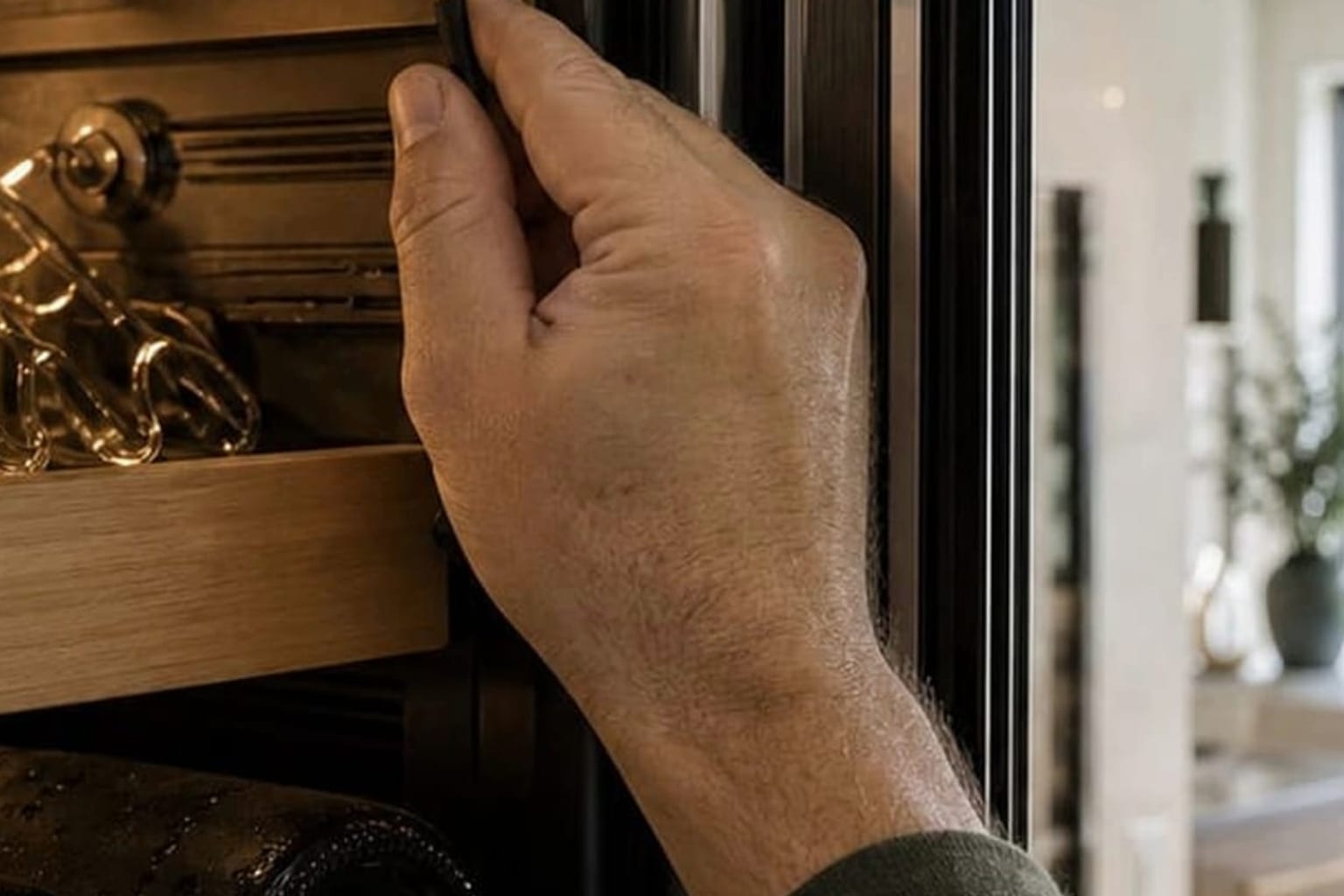
A fridge that squeaks when you open the door almost always gets that noise from one of 3 parts that rub or turn: the magnetic door gasket peeling off the cabinet frame, the hinge and closer assembly carrying the door's weight, or a custom panel brushing the cabinetry beside it. On a built-in Sub-Zero, the door gasket is the first place to look, and a 5-minute wipe-down with warm, soapy water often silences it.
Built-in, panel-ready refrigeration is engineered around a tight seal and a heavy door, so small noises appear the moment the door moves. Sub-Zero's Classic Series uses Dual Refrigeration: separate refrigerator and freezer systems that keep fresh-food odors away from frozen food and ice. Each Sub-Zero compartment has its own door and gasket, so one door can squeak while the other stays silent.
How a built-in refrigerator door seals and swings
A Sub-Zero door gasket is a flexible vinyl profile with a magnetic strip sealed inside. When the door closes, the magnet pulls the gasket flat against the steel cabinet face so cold air stays in. Opening the door breaks that grip, and the gasket peels away handle side first, hinge side last.
The Sub-Zero hinge and closer assembly carries the door's weight, which grows when a custom panel is mounted on its face, and every opening works the pivots and the closer that pulls the door shut.
Sub-Zero recommends the Classic line when a refrigerator stands freestanding or has its sides partly exposed, while Designer units show less metal and blend seamlessly into the cabinetry. Those narrow Designer reveals are a third place a squeak can start.
Why does the gasket squeak as it pulls away?
A Sub-Zero door gasket squeaks through a stick-slip effect. Spilled juice and cleaning-spray film turn tacky on the vinyl, so the gasket grips the frame, lets go in tiny jumps and chirps. Dried, aging vinyl behaves the same way.
Air pressure adds a second, normal sound. Room air that enters while the door is open cools and contracts after the door shuts, leaving the compartment slightly below kitchen pressure. Reopening within a few seconds means pulling against that small vacuum, and the Sub-Zero gasket can squeal or hiss until air rushes back in.
Wipe the gasket and the frame it touches with warm water and mild dish soap, work into the folds, then dry everything. Skip abrasive pads, bleach and solvents, which harden vinyl. A very thin film of petroleum jelly on the hinge side of a clean, dry gasket helps it release smoothly.
What makes a Sub-Zero hinge creak or groan?
A Sub-Zero hinge that creaks usually has a pivot or closer surface that has lost lubrication or started to wear. Hinge noise is usually a lower groan than a gasket chirp and changes with the door angle.
Open the door slowly and listen at each of the 2 hinges in turn. An even reveal on all 4 sides is a good sign; a corner sitting lower than the others points to sag, and a sagging door drags its gasket across the frame, so a hinge fault can sound like a gasket fault.
Adjusting a Sub-Zero hinge moves a heavy door and shifts the panel's alignment with the cabinets, so hinge lubrication, adjustment and closer replacement belong with a technician.
Can a custom panel rub against the cabinets?
A panel-ready Sub-Zero door can creak when its panel edge brushes a neighboring cabinet, an end panel or the trim above. Wood moves with seasonal humidity, so a reveal that was even on installation day can close up in a damp month.
Look along the panel edges and facing cabinets for burnished spots or scuffed paint. With the door closed, slide a sheet of paper through the gap all the way around; where the paper binds, the panel is rubbing. Do not sand or plane the panel, because the fix is usually a hinge or panel-mount adjustment.
Is the sound coming from somewhere other than the door?
Door bins: bottles shifting in loaded Sub-Zero door bins can squeak as the door swings. Unload the bins and listen again.
Drawer slides: dry or dirty crisper drawer slides can squeak when the door motion nudges them. Clean the tracks and check that nothing is jammed behind the drawer.
Freezer gasket frost: ice along a Sub-Zero freezer gasket crackles as the door breaks the frozen contact. Frost there means warm air is leaking in, so the seal or door alignment needs a technician.
Evaporator fan: a steady squeal that grows louder while the door is held open is often a Sub-Zero fan motor bearing heard through the open compartment, a job for a technician.
When should a squeak turn into a service call?
Call a technician when the squeak survives a cleaning and comes with a door that will not close on its own, a torn gasket section, frost along the seal, a low corner, or a pop from a hinge. Those signs mean the Sub-Zero seal or hinge is failing, and a poor seal makes the refrigeration system work harder.
Find the serial tag first. On Classic (BI, CL) over-and-under models it sits inside the refrigerator door near the top hinge, side-by-sides carry it inside the freezer door, and Classic French-door models carry it inside the left-hand door. The model number also shows hinge side: Sub-Zero decodes DET3050CIID/R as a Designer 30-inch combination refrigerator-freezer with right hinge, and CL3650RA/S/P/L as a Classic 36-inch all-refrigerator with left hinge. Sub-Zero Los Altos Appliance Service lists door, hinge and gasket work in a $400-$950 band.