

"The fridge feels warm" is the most common call we take across Los Altos and Los Altos Hills, and it triggers the same fear every time — that it's the compressor and the unit is finished. It very rarely is.
A built-in Sub-Zero loses its chill in a predictable order of causes, and a good diagnosis works through them from the cheap and common to the expensive and rare. Here is that order, so you can see where your unit likely sits before anyone opens it up.
Step 1 — the air it breathes
The first thing we check is the condenser. A coil caked with kitchen grease and dust makes the compressor run hot and long, and a unit that can't quite hold temperature on a warm afternoon is, more often than not, simply starved of airflow. In a Los Altos estate kitchen the built-in is boxed into custom cabinetry, so the intake grille is easy to overlook for years. A clean here fixes a surprising share of 'warm' calls outright.
Step 2 — the doors and the air inside
Next we look at sealing and circulation. A tired door gasket leaks warm kitchen air in; an evaporator fan that's failing means the cold the unit makes never reaches the shelves. Both are bounded repairs, and both present as 'warm' even though the refrigeration system itself is perfectly healthy. A column unit that's cold at the bottom and warm at the top is almost always an airflow story, not a sealed-system one.
Step 3 — the controls
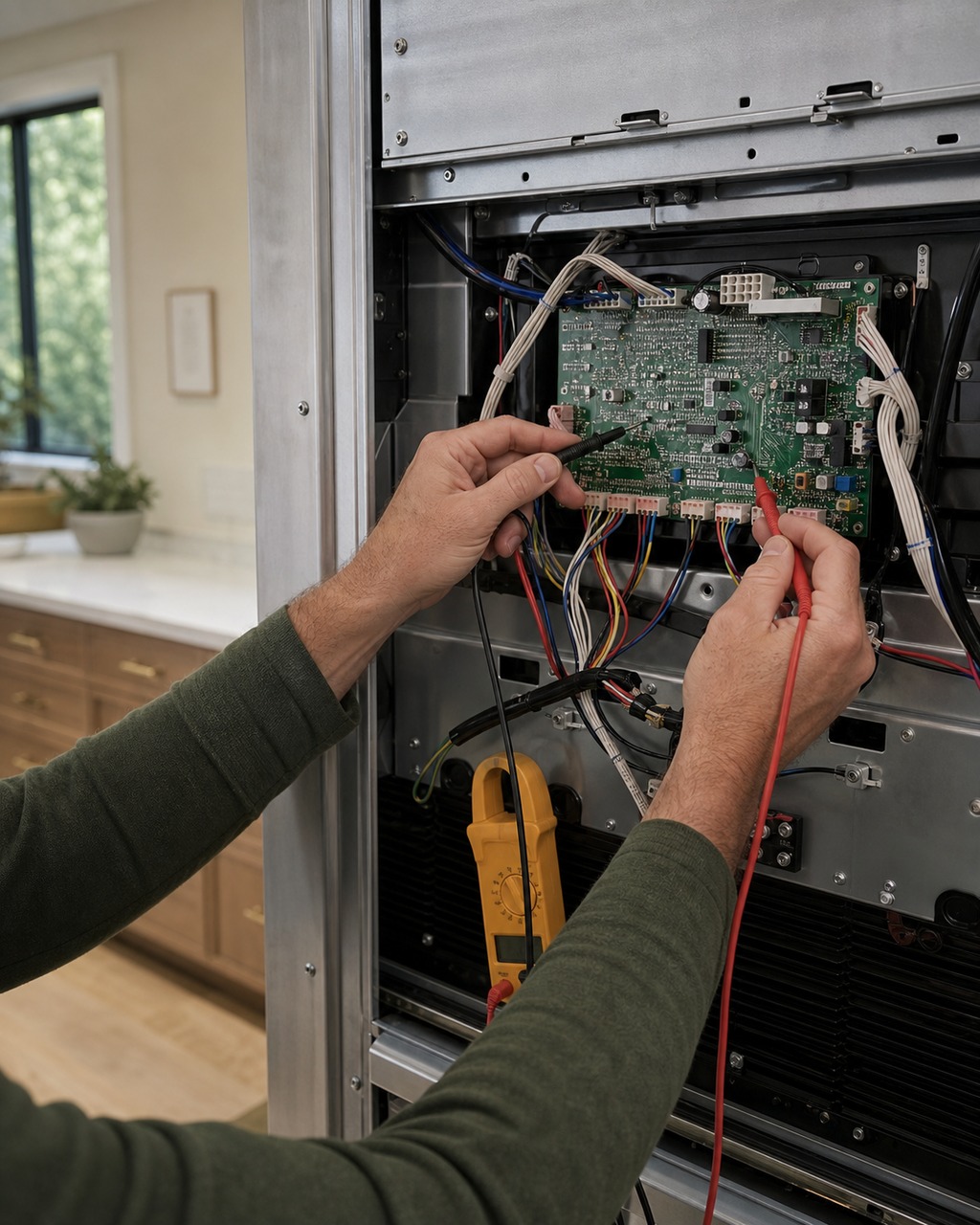
If air and circulation check out, we move to the electronics: the thermistors that tell the unit how cold it is, and the control board that acts on them. A drifting sensor can starve a column of cooling while the compressor sits idle, convinced everything is fine. These are diagnosed with readings, not guesses, and replaced as discrete parts.
Step 4 — only now, the sealed system
Last, and least often, comes the sealed system — a refrigerant leak or a failing compressor. This is the expensive one, so it's the one we prove with gauges rather than assume. On a newer unit it's usually still worth repairing; on a much older unit facing a major sealed-system bill, we'll show you the numbers and sometimes tell you honestly that it's time. We'd rather lose the job than sell you a repair the readings don't support.